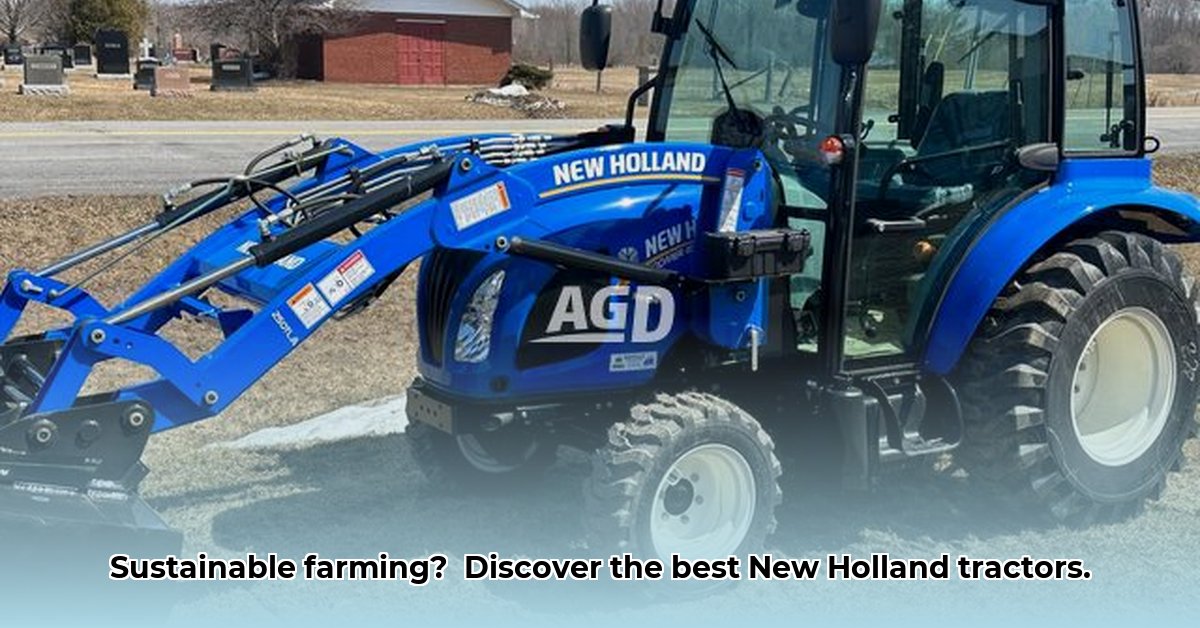
A Century of Innovation: Tracing New Holland's Agricultural Legacy
This article chronicles the evolution of New Holland tractors, examining key model advancements, technological improvements, and the ongoing commitment to sustainable farming practices. While detailed historical data on specific sustainability metrics is often limited, we analyze available information to present a comprehensive overview. This exploration highlights the industry's progress toward environmentally conscious agriculture. For additional resources, check out these free tractor manuals.
The Early Years: Power and Reliability Take Center Stage
Early New Holland tractors, introduced from the mid-20th century onward, emphasized robust build quality and raw power. These machines, primarily targeting larger-scale farms, were less focused on fuel efficiency and emissions than their modern counterparts. Precise data on fuel consumption and emissions for these early models remains scarce, hindering a complete analysis of their environmental impact. However, these tractors laid the foundation for future innovations in agricultural machinery. What was the primary focus of early New Holland tractor design, and how did this affect their contribution to sustainability?
Specialization and Diversification: Meeting Diverse Farming Needs
Beginning in the late 20th century, New Holland expanded its product line to cater to diverse farming operations. The introduction of models like the Boomer series addressed the requirements of smaller farms and specialized tasks, illustrating a shift towards more targeted machinery. This diversification increased efficiency by matching tractor capabilities to specific needs, thereby promoting sustainability through optimized resource utilization. How did this shift in production strategy aid the cause of environmentally friendly agriculture?
Technological Advancements and Improved Efficiency
Subsequent decades witnessed remarkable technological leaps in New Holland's tractor designs. Advanced transmissions, hydraulic systems, and electronic controls improved operational efficiency and reduced fuel consumption. While precise data for older models remains challenging to obtain, the trend shows a clear improvement in fuel efficiency over time. The incorporation of precision farming technologies, such as GPS guidance and sensor integration, further enhanced efficiency by minimizing overlaps and optimizing resource use. What specific technological improvements contributed most significantly to better fuel efficiency and reduced emissions in later New Holland models?
The Growing Emphasis on Sustainability: A Work in Progress
The drive toward sustainability is increasingly evident in newer New Holland tractor models. Advanced emission control systems, including exhaust gas recirculation (EGR) and selective catalytic reduction (SCR), have played a critical role in reducing harmful emissions. However, accessing comprehensive data on the complete environmental impact of all models, across all years, remains a challenge. The lack of readily available historical data on sustainability metrics, such as fuel efficiency and greenhouse gas emissions, is a significant hurdle. Why is it so challenging to compile a complete historical assessment of New Holland's environmental impact?
A Look Ahead: The Future of Sustainable Agriculture
Future New Holland tractor models are likely to incorporate even more advanced sustainability features. The exploration and implementation of alternative fuels, further refinements of emission control technologies, and expanded utilization of automation are expected. The rate at which these changes occur will be influenced by technological advancements, consumer demand, and regulatory frameworks. The ongoing collaboration between manufacturers, researchers, and farmers will ultimately determine the pace of innovation in the sector. What emerging technologies will likely play a leading role in the continued evolution of more environmentally friendly farm equipment?
New Holland Tractor Model Highlights (Illustrative Data)
(Note: This table presents illustrative data; complete historical information is not readily available)
| Model Year Range | Model Series (Example) | Horsepower Range (approx.) | Engine Size Range (approx.) | Key Features | Sustainability Considerations (Limited Data) |
|---|---|---|---|---|---|
| 1960s-1970s | Early Models | 40-70 | 3-5 Liters | Basic mechanics, manual transmission | Limited data available; low fuel efficiency assumed |
| 1980s-1990s | Mid-Range Models | 70-120 | 4-7 Liters | Improved hydraulics, power steering | Gradual improvements in fuel efficiency speculated |
| 2000s-2010s | Advanced Models | 100-200 | 6-8 Liters | Enhanced electronics, improved ergonomics | Increased focus on fuel efficiency and emission reduction |
| 2010s-Present | Modern Series | Wide Range | Wide Range | Precision farming technology, advanced emissions controls | Significant improvements in emission control and fuel efficiency |
Conclusion: Toward a More Sustainable Future
New Holland's tractors have played a vital role in shaping modern agriculture, evolving from powerful workhorses to sophisticated machines emphasizing efficiency and sustainability. Addressing the gaps in historical data through wider data sharing will help enhance our understanding of the industry's environmental journey. The future of sustainable agriculture is one of continued innovation and collaborative efforts to minimize the environmental impact of farming practices.